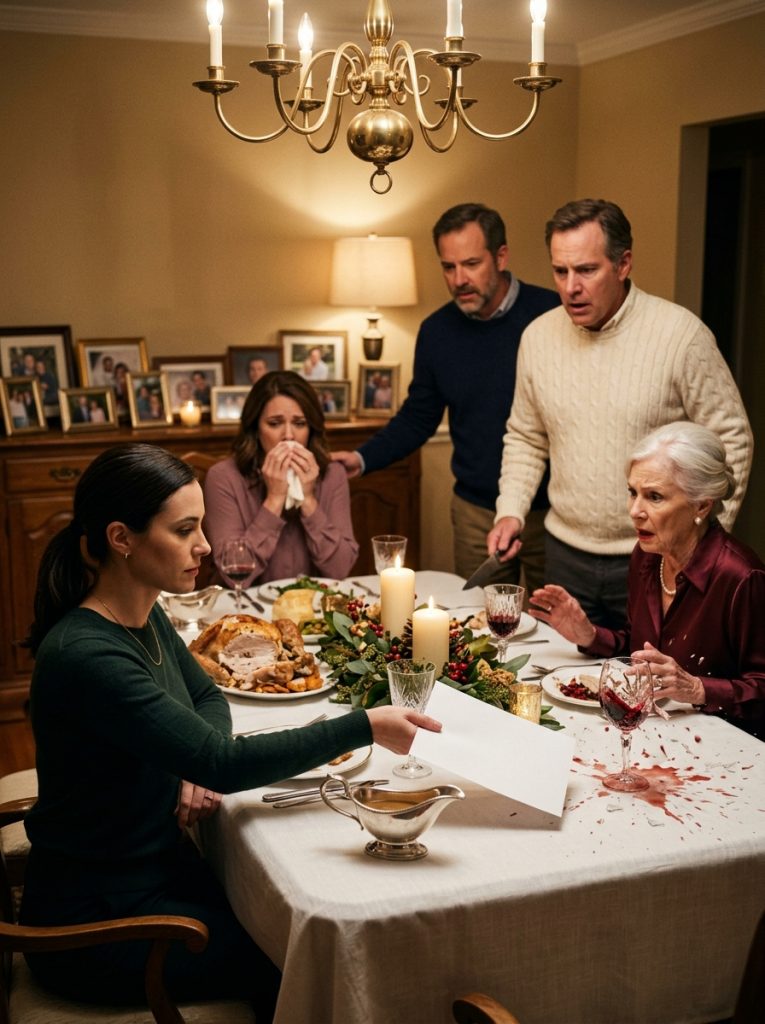
Ronald’s hand stopped just short of my shoulder.
“Cami,” he said softly. “Maybe this isn’t the place—”
“It’s exactly the place,” I said. “Thirty years of dinners in this room. I’d like one of them to be honest.”
I turned the printout around so my grandmother could read it, though her hand was shaking too hard to lift it. Down the table, Walt still hadn’t moved, the carving knife frozen over the turkey like a held breath.
“I’ll make it simple,” I said. “For anyone who wants to pretend they need it spelled out. Aunt Gloria is not my aunt. She’s my mother. Everyone at this table has always known that part. That was never the secret.” I looked at Gloria, and her face crumpled, and I felt a pang for her I hadn’t expected. “The secret is the other half. The half I got tired of feeling and never being told.”
I pointed at Walt.
“For thirty years this family said I was Gloria’s high-school mistake. A teenage girl who got herself in trouble with some boy who disappeared. Except the boy didn’t disappear. The boy carved the turkey at Thanksgiving every single year.” I tapped the paper. “Walt is my father. Gloria was seventeen. He was twenty-two and already engaged to the woman he married that spring. So the family did the tidy thing. They called me Gloria’s shame and handed me to Ronald to raise, and everyone got to keep their seating chart.”
The wine glass slipped out of my grandmother Elaine’s fingers and shattered against her plate. Red spread across the white linen like the truth finally surfacing where everyone could see it.
“Camille,” Elaine said. Her voice, eighty-two years old and still made of iron, wobbled for the first time I’d ever heard. “How dare you bring this—”
“I’m not angry, Grandma,” I said, and I realized as I said it that it was true. “That’s the thing none of you expected. I didn’t come here to scream. I came here because I’m thirty years old and I finally know why my whole childhood felt three degrees off. Why I got the small gifts. Why nobody could quite look at me. You weren’t ashamed of Gloria. You were ashamed of him.” I nodded at Walt. “And it was easier to make a little girl carry it than a grown man.”
Walt finally set down the knife.
He didn’t deny it. That was almost the worst part — he didn’t even try. He looked at Gloria, and Gloria, with tears running down into the collar of her mauve blouse, gave the smallest nod. Confirmation. Thirty years late.
“I think,” Walt said stiffly, “I should go.”
“You should,” I agreed. “You’ve been leaving since 1994. Might as well make it official.”
He stood, dropped his napkin on his chair, and walked out of the dining room. I heard the front door open and close. I felt almost nothing. You can’t lose a father you never had.
But the hand on my shoulder finally landed.
Ronald. The man who’d taught me to ride a bike in a church parking lot. Who came to every spelling bee, every recital, every 2 a.m. fever. Who I’d been about to demote to “uncle” in front of everyone.
“I need to say something,” he said, and his voice was thick. “I knew. I’ve always known. And I let them call you that word in front of me for thirty years because I told myself keeping the peace was the same as protecting you.” He shook his head. “It wasn’t. I’m sorry, Cami. I should have flipped this table a long time ago.”
“You raised me,” I said. “You’re not my uncle. You never were. Walt is just the man whose DNA I happen to share. You’re my dad. That was never in question — not in the test, not in this room, not anywhere.”
Here’s what I want people to understand, because they always ask: I didn’t do it for revenge. I don’t want Walt’s name. I don’t want a place in his will or a seat at his real family’s table or even an apology — an apology now would just be him trying to feel better, and I’m not in the business of making him comfortable.
I did it because a person deserves to know the shape of their own life. For thirty years I’d been handed a story with a piece cut out, and everyone around me could see the hole and agreed not to mention it. That does something to you. It makes you distrust your own sense of the room.
I just wanted the room to be real. Finally.
We didn’t finish that Thanksgiving dinner. You can’t, really, after that. Elaine retreated to her chair by the window and didn’t speak again that night. Half the family pretended to clear dishes. Gloria found me by the coat closet and held onto me and apologized for seventeen years old, for thirty years of silence, for all of it, and I let her, because she was a scared kid once too and the same people who failed me had failed her first.
Ronald drove me home.
We didn’t talk much in the car. We didn’t have to. At my door he hugged me the way he’d hugged me at every drop-off my whole life and said, “Same time next year? My place. We’ll do our own.”
“Just us?” I asked.
“Just the people who actually show up,” he said.
I have his number saved as “Dad.” I never changed it. I never will.
The DNA test told me where I came from.
It took thirty years and one broken wine glass to learn where I actually belong.