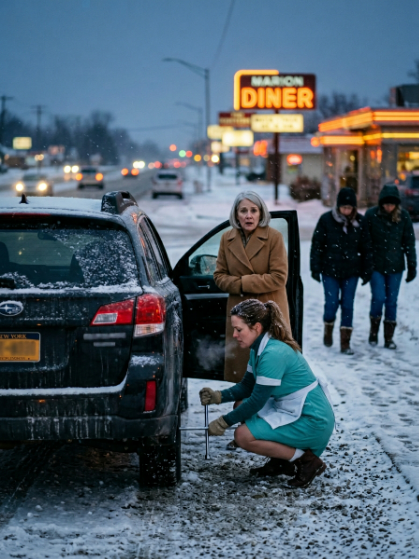
The battery caught on the second try. The SUV rumbled to life, headlights cutting through the falling snow.
Eleanor straightened up and pressed her gloved hands together like she’d forgotten what warm felt like.
“What’s your name?” she asked.
“June,” I said. “June Hale. There’s a heater in the diner if you need to thaw out before you drive.”
She smiled, a little strange. “You’ve done plenty, June.”
She wrote something in a small notebook, thanked me twice more, and pulled back onto the highway. I watched her taillights disappear and then I went back inside, clocked the rest of my shift, and honestly forgot the whole thing by the time I got home.
Three weeks later, my manager came to find me at table six.
“There’s a woman on the phone for you,” he said, looking puzzled. “Says it’s about a job.”
It was Eleanor.
Except she wasn’t a lost tourist. She was the senior vice president for site selection at a company I’d seen on the news, the kind that builds the big distribution centers that bring six hundred jobs and a tax base with them.
She’d been quietly driving through four finalist towns that week. Marion was one of them.
“I do this in every town we’re serious about,” she told me. “I take an ordinary car, I let something go wrong, and I see who stops. You learn more about a place from how it treats a stranger who can’t do anything for it than from any spreadsheet.”
In Marion, she said, eleven people drove past her. A deputy slowed down and kept going. The gas station flipped its sign rather than buzz her in.
And one waitress walked across a frozen road on her break with a cup of coffee and a set of jumper cables, and told her the honest truth about a town that was tired but good.
I told her later why I crossed that road. My mom raised me on tips and double shifts in that same diner. The winter our heat went out, a stranger paid our gas bill and never left a name. You don’t forget a thing like that. You just wait your whole life for a chance to pass it down the line.
“You told me people here stopped looking up because the jobs left,” Eleanor said. “I’d like to give them a reason to look up again.”
The company chose Marion.
I’d love to tell you it was all because of me. It wasn’t, not entirely. The land was right, the highway was right. But Eleanor said the tie-breaker, the thing that moved Marion from “maybe” to “yes,” was that on the coldest night of her trip, the town had one person in it who behaved like the kind of neighbor her workers would want.
They broke ground in the spring.
The morning of the groundbreaking, half the town turned out in their good coats. There were gold shovels and a banner and a mayor who’d never said two words to me suddenly knew my name. I stood at the back. Eleanor found me anyway and pulled me up to the front row, where I didn’t think I belonged, and where I cried a little in the cold and blamed it on the wind.
Six hundred jobs, then more. Dale from the hardware store — one of the men who’d driven past her — got the contract to supply half the build-out. He never knew how close he came to costing the whole town. I never told him. Eleanor asked me not to, and she was right. It wasn’t about shaming anyone. It was about who we want to be when no one’s keeping score.
They offered me a job too. Community liaison, they called it. I told them I didn’t have a degree. Eleanor said she wasn’t hiring a degree, she was hiring whatever made me cross that road.
I kept my shifts at the diner for a while anyway. Old habits. But the diner’s busier now, full of construction crews and new hires, and the booth by the window where I first saw a stranger in trouble has a little brass plate on it that I find embarrassing and secretly love.
Eleanor still stops in when she’s in town. She always sits at that booth. She always orders coffee.
And she never, ever lets me pour it for her without leaving enough of a tip to make me laugh.
Turns out the whole town was being watched that night.
Only one of us knew the right thing to do when we thought nobody was.