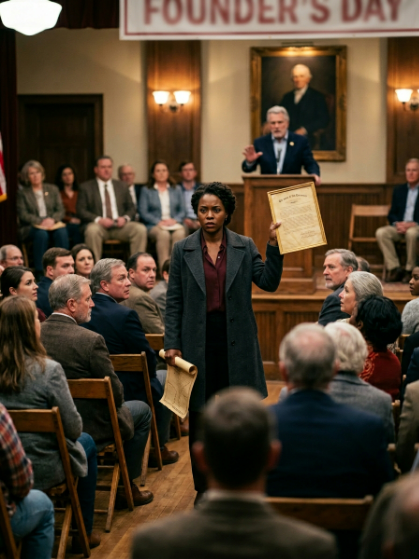
The county clerk made her way to the front of the hall, and you could have heard a pin drop on the old wood floor.
Her name was Ruth Alvarez, and she’d kept Caldwell County’s records for thirty-one years. Nobody in that room could call her a liar without calling the whole town one.
She took the framed deed from my hands and held it under the light. She unrolled the survey beside it.
“This is the original tract grant,” she said, slowly, to the whole room. “Filed and sealed nine years before the Vance family is recorded as arriving. The seal is genuine. I’ve seen a hundred like it.” She looked up. “The name on it is Mercer. Eli Mercer.”
My great-great-grandfather.
A murmur went through the hall like a crack running through ice.
Harlan Vance came off the lectern fast. “Records get forged. That proves nothing. My family built this town—”
“Your family renamed this town,” I said.
I held up the second thing I’d brought. A bundle of letters, brittle and brown.
“My grandfather spent his life trying to clear his father’s name,” I said. “The town called the Mercers squatters. Thieves. Said we’d taken land we had no right to. They ran us off it. My grandfather died with that word — thief — printed next to his name in your newspaper.”
I turned to the crowd. People I’d grown up beneath. People who’d whispered when I walked into the diner.
“These letters are from the original county surveyor to Eli Mercer,” I said. “Confirming his claim. The same surveyor whose later records the Vance family bought, and edited, and donated to the historical society with three pages quietly missing.” I looked at Ruth. “The originals are in the state archive. I requested certified copies. They’re in this envelope.”
Ruth took them. She read. Her face changed.
“These are authentic,” she said quietly. “And they do not match the version on display in our museum.”
The hall erupted.
Harlan Vance stood very still while a hundred years of his family’s story came apart around him. The brass pin on his blazer suddenly looked like a costume.
“My grandfather believed every word of what he taught me,” he finally said, and for the first time he sounded like a man and not a monument. “I didn’t know.”
“Maybe you didn’t,” I said. “But the museum knew. The historical society knew. Somebody in your family knew enough to remove three pages.”
It didn’t all resolve that night. These things don’t.
The historical society didn’t go quietly. The board member who’d accepted the “donated” records — and quietly let three pages go missing — insisted it was an innocent gap, a filing error from decades back. But Ruth Alvarez pulled the donation log. The pages were listed on the intake inventory the day they arrived. They were on the record going in. They were gone coming out. You can call a lot of things an accident. You cannot call that one.
He resigned from the society before the year was out. Not charged with anything — the man who actually removed them was long dead — but finished, in the way a small town finishes you, with no vote required.
But it resolved.
The state historical commission reviewed the documents. The certified survey held. Within four months, the museum’s “Founding of Caldwell County” exhibit was rebuilt — with the Mercer grant at the center of it, and a plain card explaining the correction.
The statue in the square stayed, but a second plaque went up beside it. It names Eli Mercer as the documented original landholder. It uses the word that took my family a century to earn back.
Rightful.
The newspaper that called my grandfather a thief ran a front-page correction. Seventy years late. I framed it and hung it next to his photograph.
Some of the town apologized. Some of them still cross the street when they see me, embarrassed by a story they helped carry for three generations. I’ve made my peace with both kinds.
Harlan Vance came to my door once, hat literally in his hands, and asked if there was anything he could do.
“Tell it right,” I said. “At the next Founder’s Day, you tell it right. That’s all I ever wanted.”
He did. I sat in the third row and watched him do it.
My grandfather never got to hear his father’s name said with respect in that hall.
But I stood up, and I said it.
And this time, the whole town stood up with me.