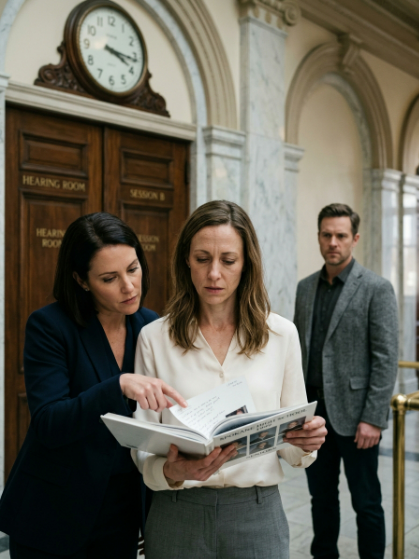
The hearing room smelled like floor wax and old paper. The wall clock that had counted down my whole life ticked toward two o’clock.
My attorney, Maya, stood with the yearbook open in an evidence sleeve.
“Your Honor,” she said, “the State’s original case rested on a propped side door, a key-card log, and a maintenance sign-out sheet from the night of the theft. The defense was never given that sign-out sheet for independent analysis. We have it now.”
She laid two images side by side on the screen.
On the left, a four-word inscription from a high school yearbook. You’ll regret crossing me. Signed, in a sharp backward-leaning hand, by a seventeen-year-old named Kyle Brandt.
On the right, the maintenance sheet from the night the safe was emptied. A signature scrawled where the after-hours log required one. The same sharp backward lean. The same strange way the writer crossed his letters.
“A forensic document examiner has reviewed both,” Maya said. “Her report concludes, to a reasonable degree of certainty, that the same hand wrote both documents. My client did not work maintenance. My client never signed that sheet. The man who propped that door and signed himself in that night was the State’s own star witness.”
In the gallery, Kyle Brandt sat very still in his gray sport coat.
I didn’t look at him. I’d spent eleven years imagining that face. I didn’t need it anymore.
The prosecutor objected, argued, asked for time. But the examiner testified. And then a second witness took the stand — a man who’d worked the loading dock back then, who’d carried his own guilt for a decade.
He said Kyle had laughed about it once, years ago, drunk at a reunion. Said he’d “handed the cops a gift-wrapped suspect.” Said the man had even kept a kind of trophy: that he’d written in some girl’s yearbook he was going to make her pay, back before he’d figured out how.
The man on the dock had said nothing for years. He looked at me when he finished. “I’m sorry,” he said. “I should’ve come sooner.”
I believed the second half of that.
Maya was relentless. She walked the judge through every place the original trial had simply stopped looking. The side door that was never dusted. The log sheet handed to the jury as background instead of evidence. The detective who’d decided on a suspect in the first forty-eight hours and spent the rest of the investigation proving himself right. None of it had been malice, exactly. It had been the easy story, and I had been the easy name to write into it.
It took the judge nine days to rule. Nine days that felt longer than some of the years.
When the order came, it used the words I’d stopped letting myself imagine. Conviction vacated. Actual innocence. The case against Kyle Brandt was already being built before the ink on mine was dry.
I walked out of that courthouse on a Tuesday afternoon into a daylight that felt too bright, too loud, too much.
I want to tell you it felt like winning.
It felt like standing in the doorway of a house that had burned down while I was away.
My mother wasn’t there to see it. She died in my third year inside, and they wouldn’t let me go to the funeral. My fiancé had a wife and a mortgage and a life that had moved on without me, the way lives do. The job I’d loved, the apartment, my twenties, my thirties — those don’t get vacated. There’s no order that gives those back.
But there was a courthouse step, and there was sun on it, and there was air that nobody was timing.
A reporter asked me if I was angry.
I thought about the seventeen-year-old girl who got that yearbook signed and laughed it off as a joke. I thought about how long a threat can wait before it comes true, and how long the truth can wait to answer it.
“I lost almost everything to four words,” I said. “And four words gave it back. I’m going to go find out who I am with the time I’ve got left.”
Then I walked down the steps, past the man who’d stolen those years, and I didn’t slow down.
For the first time in eleven years, I had somewhere to be, and all the time in the world to get there.