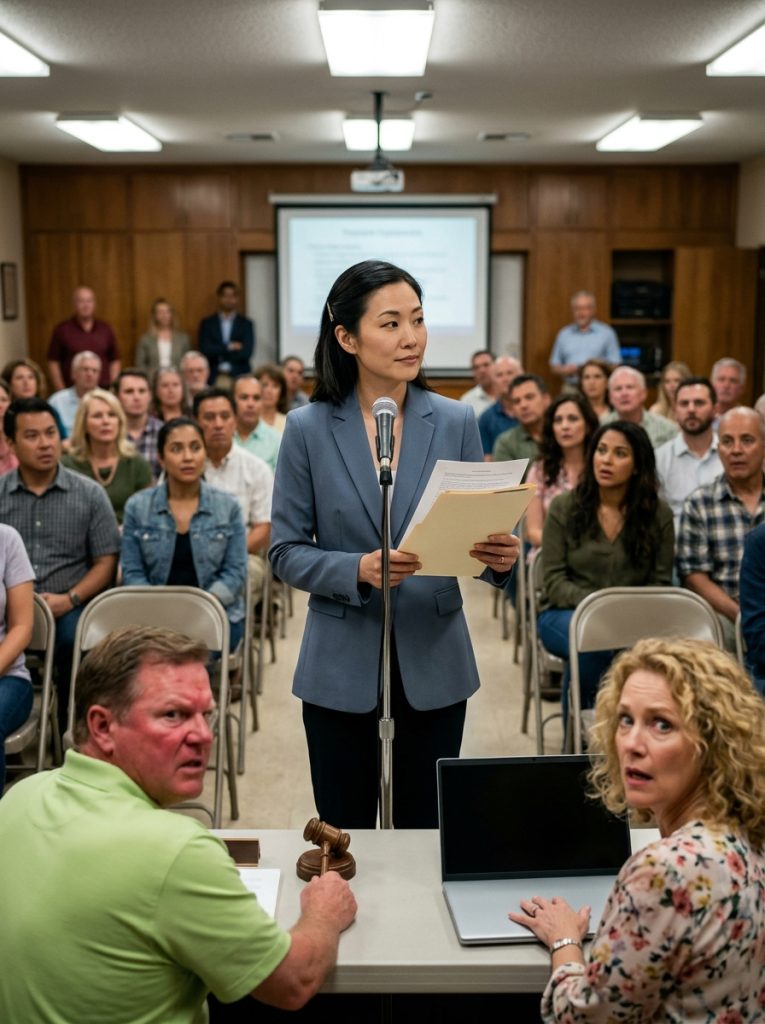
Roger banged his little gavel like it could make the question disappear.
“This meeting is adjourned,” he announced.
“You can adjourn the meeting,” I said. “You can’t adjourn the public record.”
I turned around and spoke to the room instead of the board, because the room was who it belonged to.
I held up the first page. I didn’t read the numbers off it — half the trick of my job is knowing that people don’t need the numbers, they need the shape of the thing.
“Our dues went up forty percent this year,” I said. “We were told it was for landscaping and ‘reserve health.’ I pulled the association’s bank records, which any owner can request and which I requested in writing three times. I pulled the county permit database, which is public. And I pulled the contractor’s lien filings, which are also public.”
I laid them side by side on the folding table so the front rows could see.
“In March, thirty-one thousand dollars left our reserve account, coded as ‘common area improvement.’ There were no common area improvements in March. I walked every inch of this place. The fountain still doesn’t work.”
A nervous laugh somewhere in the back.
“That same week,” I said, “the county issued a residential permit for a kitchen remodel and a pool, and the contractor who pulled it is the same contractor we paid. The permit address isn’t the clubhouse. It isn’t common area.” I looked at Cynthia, whose hand was still flat on her laptop like she could keep the truth inside it. “It’s the treasurer’s home address.”
Cynthia’s mouth opened. Nothing came out.
Roger tried to save it. “There’s a reasonable explanation—”
“Good,” I said. “I love reasonable explanations. I do this for a living. Show me the invoice for the common-area work, show me the board vote approving a thirty-one thousand dollar expense, and show me the second bid the bylaws require for anything over ten thousand. Three documents. If you have them, I’ll apologize to this room right now.”
He didn’t have them. Of course he didn’t. If they’d existed, I’d never have had to stand up.
Here’s the thing about people who run small things like little kingdoms: they count on no one ever doing the boring work of reading. Roger had been president for nine years. Cynthia had been treasurer for seven. They’d stopped expecting anyone to check, because no one ever had.
They picked the wrong cul-de-sac to stop expecting it.
A retired man in the third row — Mr. Okafor, who I’d later learn had been quietly suspicious for years — stood up and made a motion for an independent audit. It was seconded before he finished the sentence. The room voted by raised hands, and it wasn’t close.
The audit took a forensic accountant six weeks. Not me; I gave my files to the board and stepped back, because the work only counts if the person doing it has no dog in the fight. It confirmed everything and found more. Almost sixty thousand dollars over three years, routed through padded invoices and a “maintenance” account only Cynthia and Roger could see.
Cynthia resigned and then, when restitution was demanded, agreed to a repayment plan rather than face the referral the board voted to send to the county attorney. Roger resigned too, insisting the whole time he “didn’t know,” which may even be true, and which is its own kind of indictment for a man who signed every check.
The neighborhood held a special election. They asked me to run for the board. I said I’d serve as treasurer on one condition: the financials get posted, in full, to a folder every owner can open, every single month.
That’s the part I’m proudest of. Not the meeting. Not the gotcha. The folder.
Because the fountain works now. The dues came back down. And nobody on this street has to be a forensic accountant to know where their money goes, because it’s all right there, in the light, where money is supposed to live.
At the next block party, a kid asked me what I do for work.
“I find money that wandered off,” I told her.
She thought about that and asked if it was like being a detective.
Sometimes, I said. But mostly it’s just reading the page everyone else assumes nobody will.