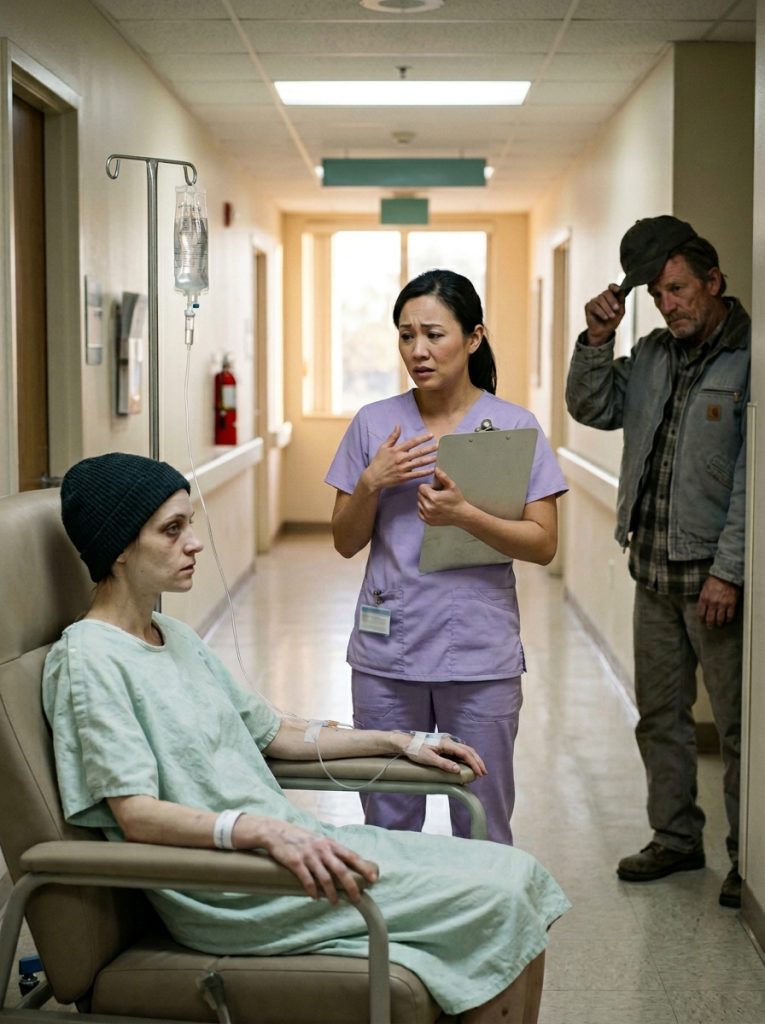
I was twenty-nine, lying in a transfusion chair with a needle in my arm, when a nurse accidentally told me my father loved me.
I should explain the chair first. I have a rare blood disorder — the kind where, when my counts crash, finding donor blood that actually matches me is not a sure thing. It’s a rare type on top of a rare profile, and every crisis turns into phone calls and waiting and hoping somebody on a registry somewhere says yes in time.
This time, somebody had. Anonymous donor, perfect match, delivered just before things got dangerous. I didn’t think much about it. You learn not to ask too many questions about the miracle that keeps you alive. You just take it and say thank you to the ceiling.
Here is the story I grew up with: my father left when I was nine. Walked out, didn’t look back, didn’t want us. That was the single agreed-upon fact of my childhood, repeated by my mother and my grandmother and every aunt at every holiday until it was load-bearing. He left. He didn’t want you. I built twenty years of myself on that foundation — every trust issue, every time I assumed people would leave, all of it anchored to a man who supposedly couldn’t be bothered.
So there I am, IV taped to my left arm, knit cap on because the medication took my hair, feeling about as sorry for myself as a person can feel, when Bonnie — my transfusion nurse, lavender scrubs, the warm chatty kind — checks my line and says, easy as anything:
“Your father will be so relieved the count held. He’s been out in that hallway all morning.”
I said, “My father?”
And I watched her whole face change as she heard what had just come out of her own mouth.
She tried to walk it back. Patient privacy, she shouldn’t have, please don’t repeat it. But you can’t un-ring that. The anonymous donor — the rare match who, it turned out, had been quietly listed and on file for years, showing up whenever my type came up critical — wasn’t a stranger.
It was him. The man who didn’t want me had been giving me his blood, type-matched and waiting, longer than I’d known I was sick.
I made Bonnie tell me where. She pointed down the hall, to the corner, and there he was. Fifty-eight years old, gray work jacket, calloused hands, turning a ball cap around and around like it might come apart. Too afraid to come closer. He’d been there all morning and hadn’t said a word, because — I’d learn in the next hour — he wasn’t sure he was allowed to.
I had a wheelchair brought, and I went to him, IV pole and all.
What he told me in that hallway took apart twenty years in about twenty minutes.
He didn’t leave. He was pushed out. When I was nine, there’d been an ugly stretch — my parents’ marriage was ending badly — and a false accusation got made in the heat of it, the kind that, true or not, ends a man’s access to his child overnight. He was told, by lawyers and by my mother’s family, that the cleanest thing for me, the safest thing, was for him to disappear. That fighting it would only drag a nine-year-old through years of mud. My grandmother, who never forgave him for the divorce, made sure the door stayed shut and made sure the story stayed simple: he left.
He believed them that vanishing was the kindest thing. It’s the great regret of his life. He says he knows now it wasn’t kindness, it was just easier for everyone except me.
But he never actually left. Not really. He kept tabs the only ways a shut-out parent can. He knew when I graduated. He knew, somehow, when I got diagnosed — and the day he found out, he drove to a blood center and got himself typed and listed, and he made them flag it so that any time my rare profile came up, they’d call him first. For years. Anonymous, because he was sure that if I knew, I’d refuse it out of everything I’d been taught to feel about him.
He’d rather I hated him and lived than knew him and didn’t.
“I wasn’t going to tell you,” he said, looking at the cap in his hands instead of at me. “I just needed to be in the building. In case the numbers went the wrong way.”
I don’t fully forgive everyone in this story. My mother and I have had hard conversations since, and some of them aren’t finished. I understand fear, and I understand a marriage falling apart, but twenty years is a long time to let a child believe she was unwanted to spare the adults a harder truth.
But my father — the man I was raised to resent — had been keeping me alive from a hallway, asking for nothing, not even to be seen.
We’re not magically healed. You don’t get the twenty years back, and I won’t pretend a single conversation rebuilt what was taken. There’s grief stitched right through the relief — grief for all the ordinary days we don’t get to have already had.
But he comes to the appointments now. Openly. He sits in the chair next to mine when he’s not the one donating, and he turns that same ball cap in his hands, and we talk about small things, building something slow out of the time we do have.
I was handed a story my whole life: he left, he didn’t want you.
It took a tired nurse’s slip and a needle in my arm to find out the truth was almost the exact opposite. He stayed in the only way they left him — in my blood, in a hallway, waiting to see if I’d make it.
If there’s a wall in your family built out of one “fact” everyone agrees on, it might be worth knocking on it. Sometimes the person on the other side has been standing there the whole time.