The person who picked up on the second ring was Marvin Goldfarb.
My mother’s attorney for thirty years. The man who handled her estate, her investments, and — though I didn’t fully understand it yet, standing frozen on that porch — her final wishes.
“Claire,” he said, and I heard him already reaching for his coat. “Where are you?”
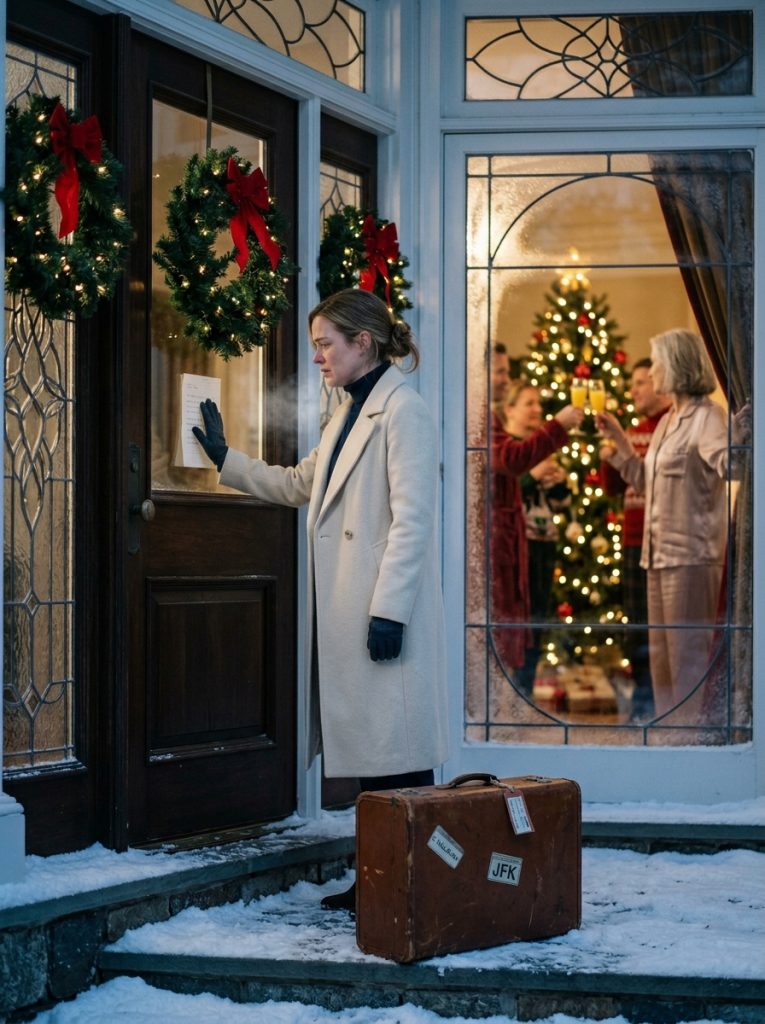
“Standing outside Mom’s house,” I said. “On Christmas morning. My key doesn’t work. There’s a note on the door with everyone’s name but mine.”
The line went very quiet.
“Diane told me you declined to attend the will reading,” Marvin said slowly. “Last month. She said you’d moved on with your life in Seattle and didn’t want to be involved.”
I closed my eyes. “Marvin. I never got a notice. What will reading?”
A pause. Then, in a voice that had gone cold and precise: “Don’t go anywhere. Don’t argue with them. Don’t let them provoke you into leaving. I’ll be there in ninety minutes.”
So I waited.
I waited on the porch of my dead mother’s house while my family drank mimosas eight feet away on the other side of a locked door. Whitney peeked through the curtain once, saw me still standing there, and let it fall. At one point my father — quiet, gray, the man who’d let Diane run his life for eleven years — appeared in the doorway of the kitchen, saw me, and turned away like I was weather.
The snow kept falling. I stopped feeling my feet around hour two.
At 9:04, a black sedan pulled into the drive. Marvin got out in a gray overcoat with a leather folder under his arm and a second man I didn’t recognize, younger, in a navy parka.
“That’s a process server,” Marvin said, nodding at the younger man. He climbed the porch steps, looked at the note taped to the door, and something in his jaw tightened. “Three names. And not the trustee’s. Interesting.”
“The what?”
“Knock on the door, Claire,” he said gently. “Let’s let your stepmother explain it to all of us at once.”
I knocked. This time, the music inside cut off.
The door opened on the chain. Diane’s face appeared in the gap, silver pajamas, mimosa still in hand, that practiced warmth she used like a weapon. “Marvin. What a surprise. We’re in the middle of a family Christmas—”
“Open the door, Diane.”
“I don’t think—”
“Open the door, or the next time it opens it’ll be for the Greenwich police, and I’d hate for the neighbors to see that on Christmas.” He said it pleasantly. That was the terrifying part.
The chain slid back.
Inside, the house I grew up in glowed with my mother’s ornaments and somebody else’s brunch. Spencer stood by the fireplace in his cashmere. Whitney pulled her red robe tighter on the stairs. My father sat down very slowly, like his legs had decided for him.
Marvin opened the folder.
“In 2022,” he said, to the room, “Eleanor Bennett placed this house, and the majority of her liquid estate, into a living trust. She did this eighteen months before she died, of sound mind, with two witnesses, one of them her physician.” He turned a page. “She named a single trustee. Not her husband. Not Spencer. Not Whitney.” He looked up. “Her eldest daughter. Claire.”
The silence had a texture to it.
“That’s not possible,” Diane said. “The will—”
“The will is a separate, smaller document, and you’re welcome to it,” Marvin said. “It distributes her personal effects. But the house was never in the will, Diane. The house was in the trust. It has belonged to Claire, legally, since the day Eleanor signed it. Which means,” he turned to me, “the locks you changed last night were changed on the trustee’s property. Without the trustee’s consent.”
I watched it land on them one by one.
“You sent the hearing notice to my old Seattle address,” I said. The pieces were assembling themselves now. “The apartment I left seven years ago. So I’d miss it. So you could stand up in front of a judge and say I didn’t care.”
Diane’s mouth opened and shut.
“She did more than that,” Marvin said. “She filed an occupancy claim asserting that the trustee had abandoned the property. That’s why your key didn’t work — she had it rekeyed under that claim.” He closed the folder. “It’s fraud, Claire. Quiet, well-dressed, Christmas-morning fraud. And it’s over.”
What happened next took less than three hours and felt like a documentary I was watching from far away.
The Greenwich police were polite. They did not put anyone in handcuffs on Christmas. They simply explained, very clearly, that the woman standing in the cream coat was the legal owner, that the others were guests who had been asked to leave, and that the matter of the fraudulent occupancy filing would be handled by the court in January.
Spencer left first, muttering about lawyers. Whitney cried, which I think was mostly about the audience. Diane was the last. She stopped in the doorway, looked at me with all the warmth finally gone, and said, “Your mother would be ashamed of you.”
“My mother,” I said, “put the house in my name because she knew exactly what you’d do the second she was gone. Drive safe, Diane. The roads are bad.”
The will — the small document, the one with the personal effects — was read in Marvin’s office in January, with all of us present because the court required it.
Diane received exactly what my mother left her. One commemorative dollar coin, in a small velvet box, with a note in my mother’s handwriting: For your trouble.
I kept the house. I kept the ornaments. And I kept the one thing I’d actually flown across the country for — my mother’s old upright piano, the one she taught me scales on, the one nobody else ever touched.
Now, on Christmas mornings, the locks open for everyone I love and no one I don’t. There are three wreaths on the door again, because my mother liked them, and the tree stands in the window where she always put it.
And every year, before anyone else wakes up, I make coffee in the quiet, sit down at her piano, and play the first carol she ever taught me — in the house that was always, the whole time, going to be mine.