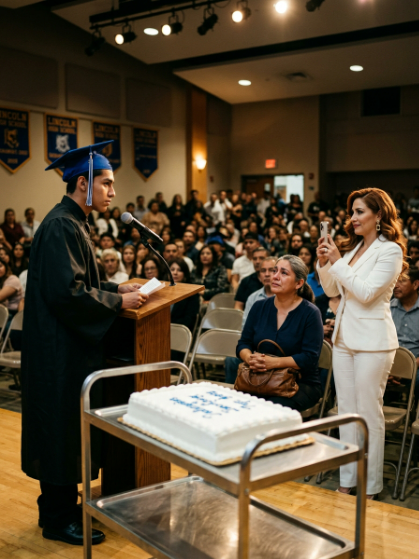
For a second, the only sound in the auditorium was the hum of the lights.
Then Mateo gripped the sides of the podium and began.
“Sixteen years ago,” he said, “my birth mother decided a baby didn’t fit the life she wanted. So she handed me to her sister and disappeared.”
Renata’s smile cracked at the corner. Her phone was still up, but her hand had started to shake.
“That sister,” Mateo said, “is Diana Flores. She’s sitting in the third row. And she is the only mother I have ever had.”
Every head in the room turned to me. I gripped my purse like it could anchor me to the floor.
“I want to tell you what ‘just a babysitter’ looks like,” Mateo said. His voice was steady, but I could hear the thing under it — sixteen years of watching me come home wrecked and pretend I wasn’t.
“It looks like cutting hair until two in the morning so the lights stay on. It looks like rice and beans five nights a week so there’s money for my field trips. It looks like sleeping in a chair next to a hospital bed when I had pneumonia at seven, because she couldn’t afford to miss work but wouldn’t leave me either, so she did both.”
A woman near me put her hand over her heart.
“My birth mother sent a card on maybe half my birthdays,” Mateo said. “Diana never missed one. Not one. And today my birth mother sent a cake.”
He finally looked at the cake on its silver cart.
“A cake that says she’s my ‘real mom’ because I’m valedictorian now. Because there’s a scholarship now. Because suddenly I’m worth showing up for.”
Renata stood. “Mateo, baby, that’s not—”
“You don’t get to call me that,” he said. Quiet. Final. The whole room felt it.
Then he reached into his gown and pulled out the speech he’d folded away. He held it up.
“This was my real speech,” he said. “About college and the future. I’m not giving it. Because none of that future exists without one person, and she has been called a babysitter in front of my entire graduating class, and I’m done letting people decide she doesn’t count.”
He set the paper down.
“Diana Flores. Tía. Mom. Will you stand up?”
I couldn’t move.
Then the guidance counselor in the back row stood first. The one who’d watched me sign every permission slip. Then Mateo’s old teacher. Then a row of parents who’d seen me at every bake sale and fundraiser.
By the time I got to my feet, half the auditorium was already standing.
Not for the valedictorian.
For me.
Renata sat back down hard, her phone finally lowering. The man in the navy suit beside her looked at her like he was seeing something he hadn’t been told about.
Mateo came down off that stage. He walked right past the cake, past his birth mother and her camera, all the way up the aisle to the third row.
And he hugged me in front of everyone, the way a son hugs the only mother he’s got.
“You stayed in that seat,” he whispered. “I told you to stay in that seat.”
“I almost left,” I admitted into his shoulder.
“I know,” he said. “That’s why I had to say it before I lost the nerve.”
The cake never got cut. A custodian wheeled it out the side door during the recessional like it was evidence from a trial nobody wanted to remember.
Renata tried to find me afterward, in the parking lot, full of explanations.
She had her story ready. That she’d been young. That she’d always meant to come back. That the cake was just a “celebration,” that I was “twisting it.”
“I paid for that cake to honor him,” she said.
“You paid for that cake to be seen,” I said. “There’s a difference, and your son just explained it to four hundred people.”
For a moment the polish slipped, and underneath it I saw something almost like grief. Maybe she did love him, in the thin way some people love things they didn’t keep. But love that only shows up for the photo isn’t the kind that raises a child.
I didn’t have anything cruel to say to her. Sixteen years of exhaustion had burned all the cruelty out of me a long time ago.
“He’s a good young man,” I told her. “You’d have liked knowing him.”
Then I got in my old car next to my son, the engineer, and we drove home to the small apartment where I’d raised him on tips and stubbornness and love.
He held the diploma the whole way.
But it was the word he’d said at that podium — Mom — that I’ll keep until the day I die.