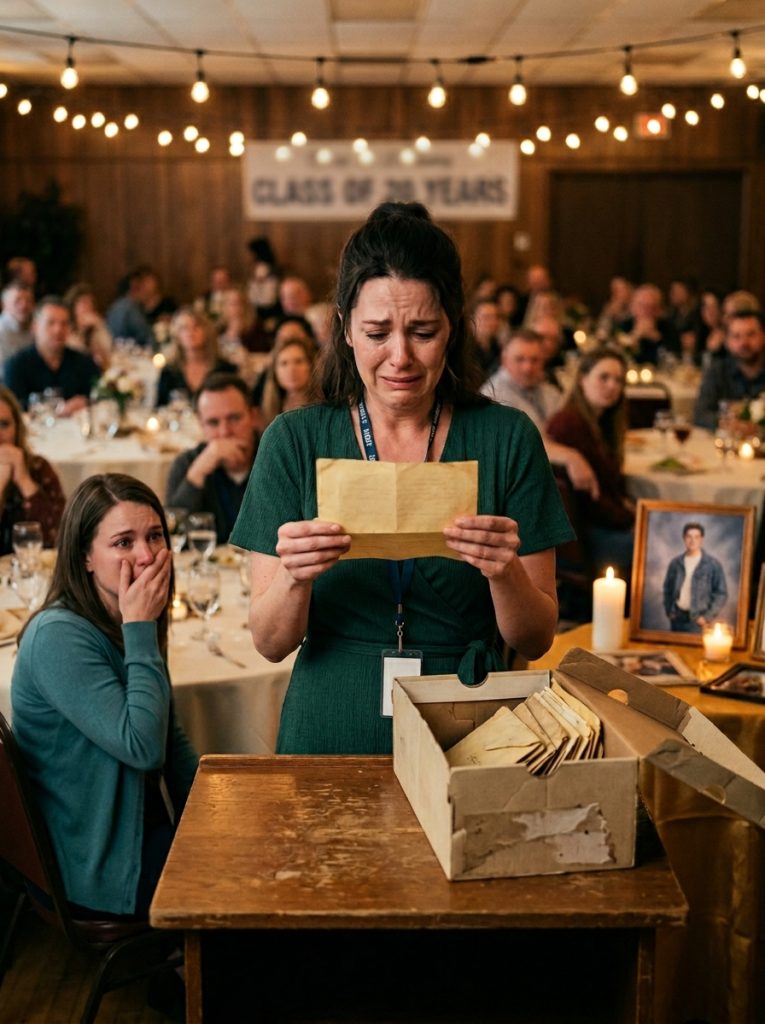
“Just toss his,” someone laughed from the back table. “He’s not coming anywhere ever again.”
The room chuckled. A few people winced. I stood at the podium with a battered shoebox of yellowed envelopes and felt my throat close.
My name is Janine Coyle. I’m 38. I organized our twenty-year high school reunion in our little town in Michigan. Senior year, our English teacher had us write letters to our future selves, sealed them, and made someone promise to hand them back in twenty years. That someone was me.
It had been a sweet night — grown adults groaning at their own teenage handwriting, promises to get rich, to marry their sweetheart, to never sell out. Until I reached the envelope marked Daniel Rourke.
Danny.
The room did that uncomfortable shuffle. Because Danny was the kid we’d all decided about. The burnout. The one who showed up exhausted, fell asleep in third period, wore the same denim jacket every single day, never came to a party. We called him a waste. A loser. Some of us said it to his face. He died nine years ago, and most of the room had barely noticed.
“Just toss his,” the voice said again.
And I almost did. Then I saw her in the front row — Ruthie, Danny’s little sister, grown now, staring at that envelope like it was the last piece of her brother on earth.
So I said, “Actually, I think we should read this one.”
I slid my finger under the flap. Twenty-year-old glue gave way. One page of careful, slanted handwriting — a seventeen-year-old boy writing to the man he hoped he’d become. I read it aloud, and by the third sentence the entire banquet hall had stopped breathing.
“Dear future me,” Danny wrote. “If you’re reading this, you made it to thirty-seven. I hope you got some sleep. I’m so tired. I work nights at the gas station on Route 9 after school because Mom’s medicine isn’t covered and somebody has to, and Ruthie’s only nine and she shouldn’t have to. Mom has the cancer that doesn’t get better. Dad left when it started. So it’s me. I do my homework in the hospital chair. That’s why I fall asleep in Mr. Avery’s class. I think he knows. He never wakes me up mean.”
You could hear people setting down their drinks.
“I know what they call me,” the letter went on. “The burnout. Goodwill kid. I want to tell them I’m not lazy, I’m just holding up a whole house with two hands. But I don’t, because explaining it to people who already decided about you is just one more thing I don’t have time for. So future me — I hope you stopped caring what they thought. I hope you forgave them. They were kids. Most of them just didn’t know. It’s okay.”
I had to stop and breathe. Nobody in that room said a word.
“Here’s my dream,” I read. “I want to be the person who shows up when everything’s falling apart. Because nobody showed up for us, and I know exactly how that feels, and I don’t want anybody else to feel it. Maybe a paramedic. The guy who comes when you call and tells you it’s going to be okay. That’s all I want to be. The one who comes.”
I lowered the page. My hands were shaking.
That’s when Ruthie stood up.
“He did it,” she said, her voice cracking across the silent hall. “He took care of our mom till the day she passed. He put me through school. And then he became a paramedic — Station 12, in Grand Rapids.” She pressed a hand to her mouth. “Nine years ago he was the first unit to a pileup on the interstate in an ice storm. He pulled two people out of a car before it caught. He went back for the third.” She breathed. “He didn’t come back out. The man he was carrying lived. Danny was thirty-one.”
The burnout. The waste. The kid we’d written off had spent his whole short life being the one who comes — and died being exactly that.
I have never heard a room go so quiet, or seen so many grown people cry at once. The man who’d said “just toss his” had his face in his hands.
We did the only thing left to do, which was everything we could.
That night we passed Danny’s shoebox around the room, and people didn’t put letters in it — they put checks. Cash. Pledges scrawled on napkins. By the end we had the start of the Daniel Rourke Memorial Scholarship: every year, money for a graduating senior from our county who’s been quietly holding up a household at home — a caregiver kid, the kind we’d all walked past for four years without seeing.
Ruthie administers it. The first recipient, last spring, was a girl who’d been getting up at 4 a.m. to dress her disabled father before school. Nobody at her school knew either. They know now.
I think about that letter all the time. Danny forgave us before we’d even earned it, in handwriting he sealed at seventeen, never imagining we’d read it without him in the room.
The cruelest thing about being too late isn’t that you can’t apologize. It’s that the person you wronged already forgave you, and you only find out once they’re gone, and there’s nowhere to put all that grief except into being better.
So we’re trying to be the ones who come.
We’re twenty years late. But we’re trying.