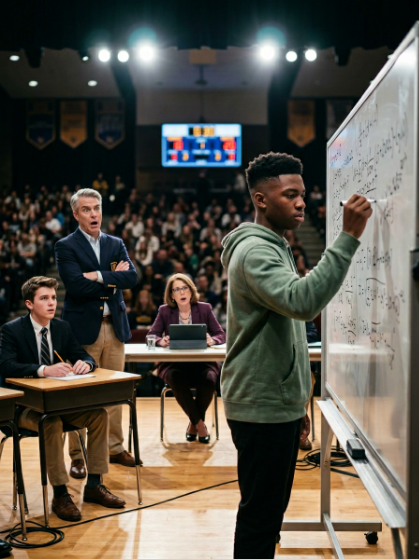
Marcus capped the marker, and the room exhaled all at once.
Dr. Pierce checked his proof against her tablet. Then she checked it again. Then she took off her glasses, which I had never once seen her do at a competition.
“That’s correct,” she said into the microphone. “Fully correct. And, frankly, more elegant than the solution in our own answer key.”
The bleachers came apart with noise. My own school’s parents — the ones in the good blazers who carpool in luxury SUVs — were on their feet cheering for a boy in a faded hoodie, because there was nothing else honest left to do.
I stood there with my arms still crossed, my certainty gone, my mouth dry as chalk.
Dr. Pierce wasn’t finished. She set her glasses down and looked, not at Marcus, but at me.
“Coach Vance,” she said, evenly, “you asked this young man to prove himself in front of everyone. He just did. Now I think the room would like to hear from the man who doubted him.”
I have replayed that walk to the microphone a thousand times since.
I could have stayed small. I’d rehearsed a hundred soft excuses on the way down the steps — about standards, about fairness, about protecting the integrity of the competition. Cowards always keep a vocabulary ready.
Instead I looked at Marcus Bell, seventeen years old, still standing beside the board he had just conquered, calm as still water.
“I owe you an apology,” I said. “Not a quiet one. A loud one. Because I did this loud, in front of all these people, and you deserve to be cleared just as loud.”
I told the room the truth.
That I had seen a kid from the east side with a broken backpack zipper and decided what he was before he ever picked up a pencil. That I’d taken an ugly assumption, dressed it up in the language of procedure, and called it concern.
“I wasn’t protecting this competition,” I said. “I was protecting a trophy, and a story I like to tell myself about who earns things in this world. He was just trying to do math.”
Afterward, in the hallway, I learned the part that finished the job on me.
Marcus works the closing shift at a grocery store four nights a week, bagging and mopping until eleven. He does his problem sets on his breaks, in the back room, by the time clock. He’s raised by his grandmother, who took two city buses to get to the auditorium and was sitting in the very back row in her good church coat the entire time I was busy deciding her grandson was a cheat.
He didn’t have a coach. He learned from library books, free videos on a cracked phone, and a retired math teacher who let him borrow her old college textbooks one chapter at a time.
I had a budget, a crest on my blazer, and a whole room at the academy just for the trophies. He had a marker and a grandmother on two buses.
Dr. Pierce caught me before I left the building.
“He qualified for nationals on pure merit,” she said. “But the travel costs real money this family doesn’t have. I’m told a certain academy has a very generous booster fund.” She didn’t blink. “Just a thought, Coach.”
We paid for the trip. All of it — Marcus and his grandmother, flights, hotel, meals — and we put no name on it, because that is how help is supposed to work. When the booster board asked who had authorized the expense, I said I had, and I meant it more than I’ve meant anything in a long time.
Marcus placed third at nationals. Third in the entire country, against kids who’ve had private tutors since the fourth grade.
My son Tyler — the captain who couldn’t crack that final problem — started texting Marcus the week we got home. They run practice sets together now, two seventeen-year-olds who met on opposite sides of the worst instinct I have ever had. Tyler is a better young man for knowing him, and I’ve told them both so.
Last month I did the hardest, best thing of my coaching career. I recommended Marcus for a scholarship I used to quietly steer toward kids who looked like mine, who came from families like the ones in the good blazers. I wrote the letter by hand, and I didn’t hedge a single word of it.
I keep one thing on my desk now. Not a trophy. I have enough trophies.
A photo of a boy at a whiteboard, marker raised, looking straight at the man who doubted him — there to remind me, every single morning, who the real test that day was actually for.
It wasn’t for him.
It was for me. And I very nearly failed it.