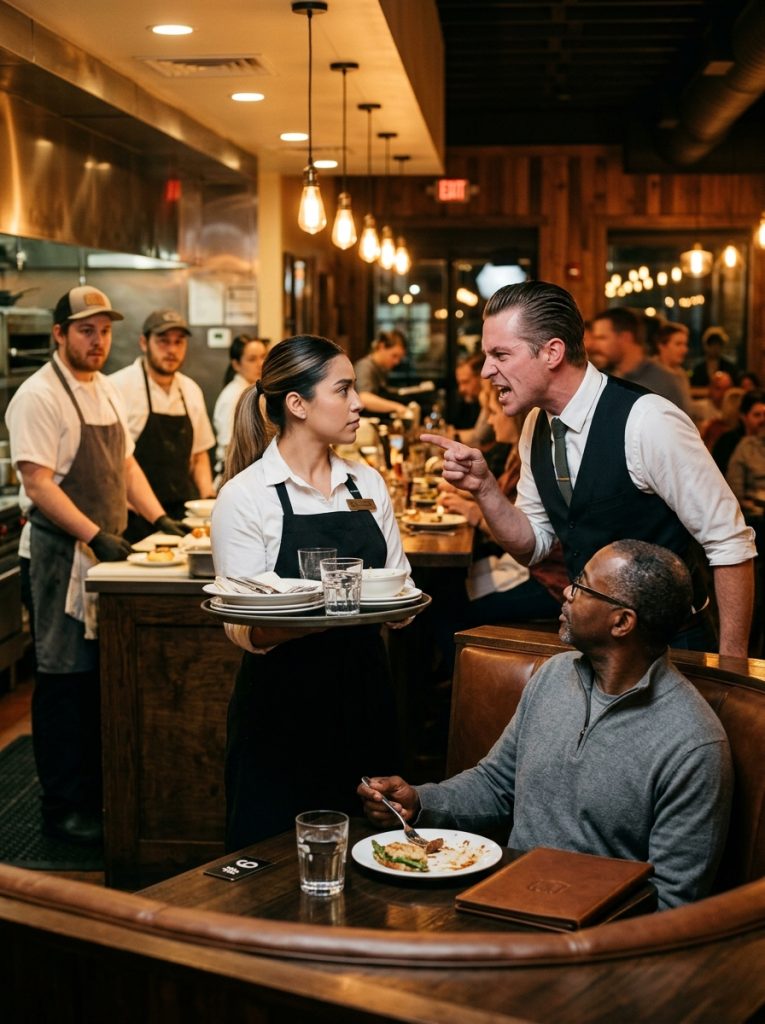
I had the quiet man at table six pegged as a bad tipper before he even ordered.
You learn to read tables fast when you’ve worked as many doubles as I have. Older gentleman, plain gray sweater, sat alone, ordered the cheapest entrée on the menu, said maybe four words. I filed him under “be polite, expect nothing,” and got on with my night.
And my night was already a bad one, because of Brent.
Brent’s our floor manager. Slicked-back hair, skinny tie, the specific kind of cruel that he saves for the dinner rush when there’s an audience. He’d had it out for me for weeks — I’d turned down going for a drink after close, and apparently that was unforgivable. So that night he was making me pay.
He “accidentally” bumped my arm so a tray of waters went down in front of a six-top. He did an impression of my accent while reading the specials, loud, so the line cooks could hear. When I asked, quietly, if we could talk after service, he laughed and said in front of two other servers, “Talk about what? You’re lucky to have a job here, sweetheart.”
I kept my chin level and my voice even. I needed the shift. I’ve got a kid at home and rent that doesn’t care about my feelings. So I swallowed it, the way you do, and kept moving.
The whole time, I noticed the man at table six watching.
Not in a creepy way. Just… attentive. Every time Brent’s voice climbed, the man set down his fork and looked up, taking it in. He caught my eye once after a particularly nasty comment, and there was something steady in his face that I couldn’t read. I refilled his water more than he needed, honestly, just to have an excuse to stand at a table that didn’t feel like a target.
Then, right after Brent humiliated me one last time by the kitchen pass — knocked a plate out of my hand and announced to the room that I was “all thumbs tonight” — the quiet man folded his napkin, set down his fork, and raised one hand.
“Excuse me,” he said, calm as Sunday. “I’d like to speak with your manager. Now.”
My stomach dropped right through the floor. I thought: perfect. The one table that wasn’t a problem is about to file a complaint, and Brent will find a way to make it my fault and I’ll be out a job tonight.
Brent practically sprinted over, all teeth, the way he turns it on for customers. “Sir! Is everything all right? I hope the service wasn’t—” and he gestured at me like I was the issue.
The man reached into his jacket and set a business card on the table. Then he told Brent who he was.
He wasn’t a customer. He was Leonard Hayes. His company had bought our restaurant group eight weeks earlier, and he had a habit — a policy, really — of visiting his new locations himself, unannounced, dressed like nobody, ordering the cheap thing, and just watching how the staff get treated when management thinks no one important is in the room.
He’d been at table six for two hours. He’d seen all of it. The waters. The accent. “Lucky to have a job here, sweetheart.” The plate. He’d been taking notes on his phone the entire time — times, quotes, the whole sequence.
“I came in tonight to evaluate this restaurant,” he told Brent, and his voice never rose, which was somehow worse than if it had. “I have everything I need.”
Here’s the part I only found out later. Hayes didn’t start at the top. He’d started his career as a teenage busser, and he’d had a manager exactly like Brent — the kind who mistakes a name tag for permission to be a tyrant. He never forgot it. So when he buys a place, the first thing he checks is how the lowest-paid person on the floor gets spoken to. He says you learn more about a business from that than from any spreadsheet.
Brent was finished that night. Not transferred, not written up — finished. And in the days after, the reason got worse for him: a closer look at the books turned up that he’d been skimming from the tip pool for months, shorting the servers and pocketing the difference. The humiliation was just the part customers could see.
Two weeks later, my paycheck looked different.
Hayes offered me the shift-lead training program — the one I’d asked Brent about twice and been laughed out of both times. Back pay for the tips Brent had skimmed off me. And a sit-down where he asked, genuinely, how the floor actually ran and what would make it better, like my answer mattered. Because to him, it did.
I’m a shift lead now. I run that floor the way I always wished someone had run it for me — which means the new hire who’s nervous and getting yelled at by a table doesn’t have to eat it alone, because I’ve got her back.
I almost wrote that man off as a bad tipper.
Turns out the quietest person in the room was the only one really paying attention. I think about that every shift. You never know who’s at table six.