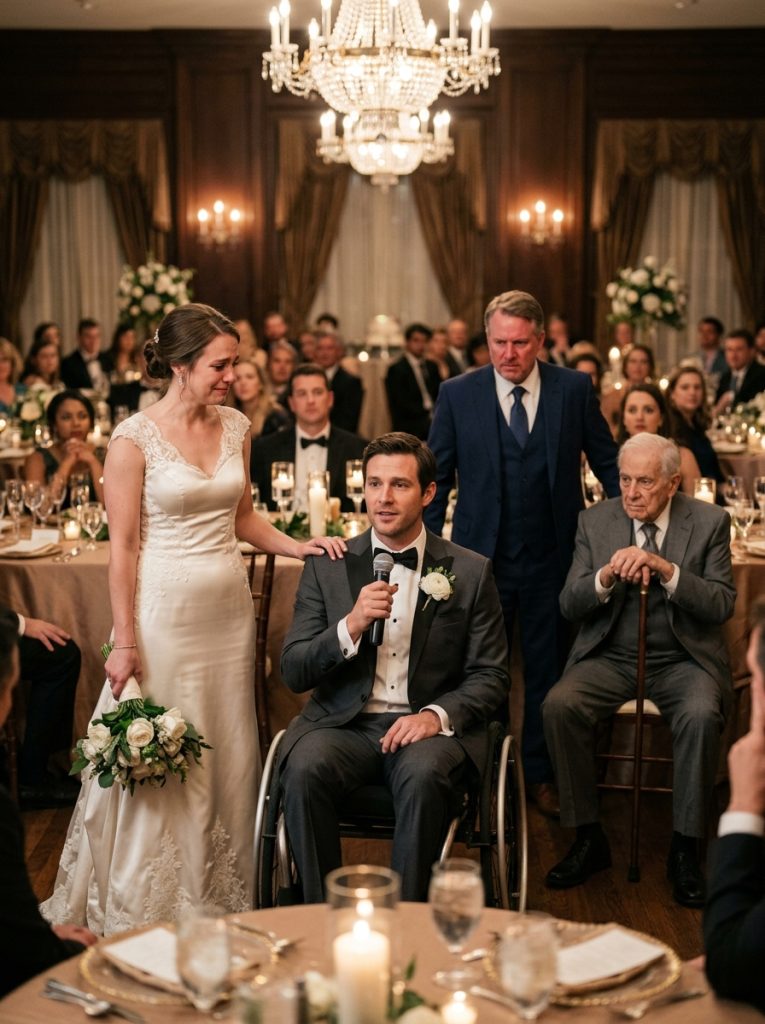
“Most of you are wondering if I can do this.”
I let that sit for a second under the chandelier. Two hundred people, dead silent, every one of them braced to be embarrassed on my behalf.
“My father-in-law was wondering it about an hour ago,” I said. “He asked me, very kindly, to let someone else give the toast. So it would flow.”
Richard’s face went the color of the wine in his glass. Grace’s head turned toward him, sharp. She hadn’t known.
“Don’t,” I said, before the room could turn on him. “He wasn’t being cruel. He was being careful. There’s a difference, and I’ve spent five years learning it from the inside of this chair.”
I looked around at them. The Ashfords. Old Charleston, old money, old certainty about how a man is supposed to stand to be worth anything.
“Five years ago a drunk driver crossed a median on I-26 and took my legs,” I said. “He didn’t take my mind, my heart, or my mouth, though judging by the seating chart, some of you were hoping it was a package deal.”
A nervous laugh, here and there. Then more.
“I didn’t roll out here to make anyone uncomfortable. I rolled out here because the woman I married is the best human being I have ever met, and a man does not let someone else speak for the best thing that ever happened to him. Not the best man. Not the father-in-law. Not anybody.”
I told them how I met Grace. How I was three months out of rehab and convinced no one would ever look at me the way people had before, and she walked up to me at a friend’s barbecue and said my chair was blocking the good shade and could I budge over. Not pity. Not careful. Just a woman who wanted the shade.
I told them she never once made me feel like a project. That she argued with me, beat me at cards, let me fail and didn’t rush to catch me. That love, the real kind, isn’t lowering the bar for somebody. It’s refusing to.
“So here’s my toast,” I said, and I lifted the glass from the holder on my armrest. “To Grace, who never asked me to be less so she could feel like more. And to this family —” I looked right at Richard “— who I am proud to join, and who I hope will get to know me as something other than the thing they were afraid would embarrass them at a party.”
That should have been the end of it. A good speech. A redeemed moment.
It wasn’t the end.
Because at the back of the room, old Walter Ashford — eighty-four years old, the patriarch, the man the whole family quietly orbits in fear — put both hands on his cane and pushed himself up to standing.
The room turned. You could feel it. When Walter stands, everyone stands.
He didn’t look at me. He looked at his son.
“Richard,” he said, and his voice carried without a microphone the way only old authority does, “I have spent fifty years watching this family measure men by how they enter a room.” He nodded toward me. “This young man just told us more truth in three minutes than I’ve heard at this table in a decade, and he did it from a chair you tried to hide in a corner.”
Richard opened his mouth. Walter lifted one finger, and Richard closed it.
“When I’m gone,” Walter said, “this family is going to need someone in it who knows the difference between careful and cruel. Who can take a hard thing and stand up inside it.” He turned to me at last, and those sharp old eyes were wet. “Welcome, Theo. About damn time we got someone with a spine in here.”
Then Walter Ashford raised his glass to me, and two hundred people rose to their feet, and the only person at the head table slow to stand was Richard — until his own father looked at him, and he rose too, red-faced, and found my eyes across the room, and mouthed, very simply: I’m sorry.
He found me later, out on the veranda. He crouched down so we were eye to eye, which I’ve learned not many people think to do.
“I was protecting the party,” he said. “I should have been proud of the man my daughter chose. I’d like to start over, if you’ll let an old fool do that.”
I shook his hand. “I’m in the family now,” I said. “Starting over is sort of the whole point of a wedding.”
Grace found me after that, sat right down in my lap in her ivory gown in front of everyone, and put her forehead against mine.
“You took the microphone,” she whispered.
“Somebody had to,” I said.
I never did learn whether Walter had planned it — whether asking me to skip the toast was Richard’s idea or a test the old man set running just to see who’d flinch.
I decided it didn’t matter.
I took the mic that nobody wanted to hand me.
And I have never, not once, regretted the things I said standing up while sitting down.